

PepsiCo hit the headlines in more ways than one in 2025 – from its striking $1.95bn deal to buy US prebiotic soda business Poppi to the public criticism the food-and-beverage giant attracted from activist investor Elliott Investment Management.
PepsiCo may have satisfied the US hedge fund (at least for now) with a multi-faceted strategy to improve the performance of its business in North America (replete with cuts to product ranges, lowering operating costs and a focus on “affordable price tiers”) but there’s no question the company remains one of the most closely watched among the major listed consumer names.
Go deeper with GlobalData


Discover B2B Marketing That Performs
Combine business intelligence and editorial excellence to reach engaged professionals across 36 leading media platforms.
As such, yesterday’s (3 February) publication of PepsiCo’s fourth-quarter and full-year financial results – and its outlook commentary – were examined carefully for signs of whether the Gatorade and Walkers brands owner’s recent strategic changes have started to pay off.
The overall numbers
At first glance, PepsiCo’s fourth-quarter numbers looked stronger than those for the year as a whole. Net revenue, operating profit and net income all rose during the final quarter, compared to just one out of those fundamental metrics (net revenue) across 2025.
On an organic basis, PepsiCo’s revenue grew at its slowest annual rate in 2025 since CEO Ramon Laguarta took the helm in late 2018.
However, as the PepsiCo chief noted, there were signs of a pick-up in the company’s top-line performance in the final three months of the year.
“PepsiCo’s fourth-quarter results reflected a sequential acceleration in reported and organic revenue growth, with improvements in both the North America and International businesses. Accelerated net revenue growth and strong productivity savings led to strong operating margin expansion and double-digit EPS growth in the fourth quarter,” Laguarta said.
PepsiCo reports a “core, constant-currency operating profit” metric to provide an indication of its underlying profitability once factors like exchange rates and one-off items (such as restructuring charges) are removed from the numbers. The growth in that metric was stronger in the fourth quarter (up 13%) than for the full year (2% higher).
PepsiCo Foods North America saw its profits by that metric decline in the quarter and the year as a whole. It was the only division to be down in both periods.
Overall, however, PepsiCo’s fourth-quarter earnings and revenue topped Wall Street’s estimates.
The volume question
Dig deeper and it’s clear that, like many major names in food and beverage, PepsiCo continues to find growing volumes tough. Success in securing price rises to offset severe cost inflation helped drive revenue growth across the sector in 2023 and 2024 but attention has switched to whether companies can actually now sell more stuff. Can they get volumes moving upwards?
At PepsiCo, results were mixed to say the least. The company’s two North America divisions (which were the focus of Elliott Investment Management’s criticism) saw volumes decline again in the fourth quarter and across 2025.
Outside North America, PepsiCo’s business in EMEA markets reported flat drinks volumes and a 5% fall in what the snacks and breakfast cereal company calls “convenient foods”.
The units on which PepsiCo reports in Latin America and APAC are food businesses. Both saw volumes rise in 2025, though unit sales fell in Latin America in the fourth quarter.
Snacks price cuts
Ahead of PepsiCo’s results, Barclays analyst Lauren Lieberman said investor sentiment on the company “largely hinged” on the outlook for its snacks business in the US. Snacks represent the bulk of the PepsiCo Foods North America business and the division’s volumes declined in each quarter of 2025. Lieberman said investor questions centred on the success (or otherwise) of PepsiCo’s innovation in snacks in the US. She said more time was needed to assess the company’s performance in the area as it focuses on two key themes – “affordability and permissibility”.
On the latter, PepsiCo has been working to remove artificial flavours and colours from many of its US snacks products. It also plans to launch products with more fibre and protein this year.
On affordability, the company’s moves on price grabbed headlines in the US yesterday. According to Bloomberg, PepsiCo is to lower the price of certain snacks products by as much as 15% with some of the cuts in place before this weekend’s Super Bowl.
PepsiCo stated yesterday it has “begun offering greater affordability on certain packages” of brands including Lay’s, Tostitos, Doritos and Cheetos “to improve purchase frequency”.
When PepsiCo discussed its results with Wall Street analysts yesterday, it was a common theme of the questions put to the company’s management, not least in the context of not just how it might affect sales but also margins.
“We’re playing offense here,” CFO Steve Schmitt said. “We’re excited about the initiative and the benefits that will come both in volume and sales growth. From an overall perspective, this investment is manageable for the business. It’s included in our guidance.”
Laguarta emphasised PepsiCo expects higher volumes, net revenue and operating margins from its US snacks business in 2026. He said the company had been testing lower prices since the second quarter of last year and added: “We think that for some consumers, low and middle-income consumers, the biggest friction they have today in our category for faster penetration is affordability. This will be very surgical, very focused on particular brands, particular formats, particular channels, investment. And, from the test that we’ve done at scale in multiple markets, this has very good ROI for us.”
Productivity payback
Part of the strategy PepsiCo announced in December after the discussions with Elliott Investment Management included improving the company’s productivity, though the company was keen to underline it had already been doing. “We aim to deliver a record year of productivity savings in 2026, benefiting in part from the actions taken in the second half of 2025,” PepsiCo said at the time.
And, speaking to analysts yesterday, PepsiCo’s management underlined how better productivity would help pay for the investment the company was making in areas like the prices of its products.
“That’s going to help fund the initiatives that we have. You saw the productivity that we had in the fourth quarter. We expect a lot of that to carry over. That’s going to fund some of our investments. And we’ll be balanced about how we use that productivity to invest in the business and drive sales growth,” Schmitt said.
PepsiCo’s “progress” in North America drinks
The fourth quarter was another three-month period of declining volumes from PepsiCo’s North America beverage business.
The division’s reported revenue accelerated compared to the third quarter (up 4% compared to a 2% rise) and organic revenue again grew 2%. However, fourth-quarter volumes fell 4% versus a third-quarter decline of 3%.
The company said two-and-a-half points of that 4% drop was due to its case-pack water business, which had changed its distribution partner.
PepsiCo expects PepsiCo Beverages North America to “build business momentum” in 2026 and “deliver its sixth consecutive year of core operating margin expansion”.
Laguarta added: “I think we’re very happy with the progress we’re making in the beverage business. Our focus this year will be on increasing the competitiveness of the business.”
How does PepsiCo plan to do that? Laguarta pointed to “execution, affordability [and] brand building” and said: “We’re focusing on that, in particular on the soft drinks and parts of the functional hydration portfolio. We feel good about the plans and we feel good about the space and we feel good about the investments we’re going to be making. The other thing you should think about is we’ve been very consistent on improving the margins of the business and 2026 will be no different.”
North America central to 2026 targets
PepsiCo reiterated the 2026 forecasts it gave in December. The company expects its overall organic revenue to increase by 2-4% and its “core constant currency” EPS to rise 4-6%. In 2025, the first metric was up 1.7% and flat for the second.
On organic revenue, PepsiCo expects to be at the higher end of that range in the second half of the year, driven by what is the ongoing steady performance of its business outside North America and an improvement at home.
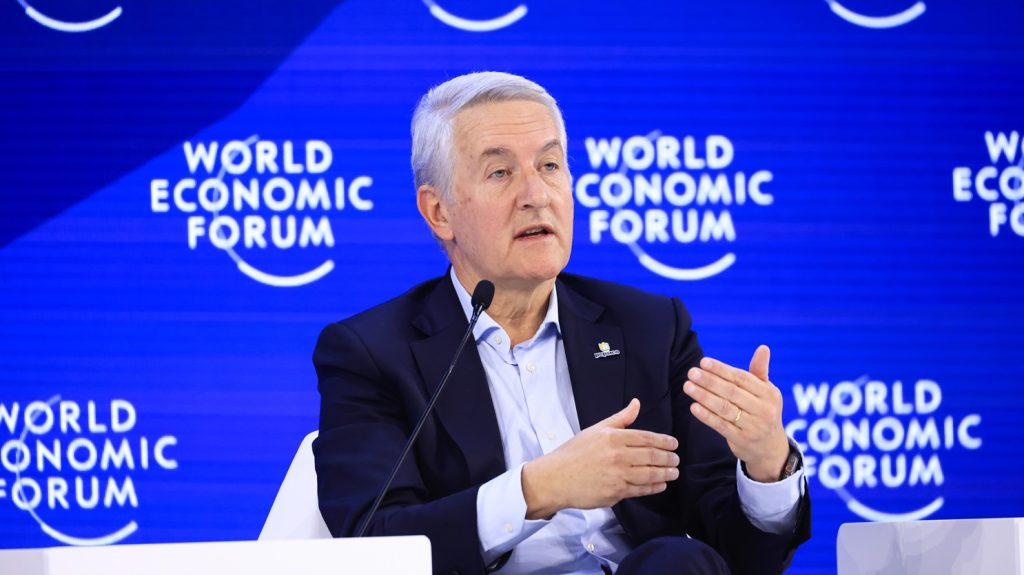
“We expect our international business to continue to perform at similar levels to last year – mid-single-digit,” Laguarta said. “We’re seeing good performance in some of our larger markets. Mexico improving in Q4 and then also having a good start [in 2026]. China as well, South Africa as well. You should think about mid-single-digit growth for our international business. That’s the way it has been performing for the last 19 quarters or so.
“The acceleration comes mostly from our North America businesses. On the beverage side, we feel good about the acceleration it had in 2024 and 2025 and we think that it will continue, so you should expect a little bit more acceleration from the beverage business.
“But, clearly, it is our food business that has been improving throughout the year both volume and net revenue. And December was better than October and we expect that obviously Q1 will be better than Q4 and so on.”
And, the PepsiCo CEO noted, the company expects to see the benefit of not just the purchase of Poppi but its move to acquire Siete Foods in October 2024. “You have some sort of a mechanical acceleration in organic from some of the acquisitions we made earlier in the year. They turn into organic throughout the year,” Laguarta noted. “That will have also some mechanical impact. But those acquisitions are in high-growth segments of the category. That’s why we did it.”


