

Rather than fully replace chocolate, cocoa-free alternatives can help bolster the resilience of the chocolate market amid volatility in supplies and growing concerns over the sustainability of production all at the same time as the sector is forecast to grow.
That’s the verdict of those operating in a chocolate industry that’s being shaken by cost and environmental pressure. The cocoa and chocolate markets have seen significant instability in commodity prices in recent years. The price of cocoa reached an all-time-high of $12,906 per metric tonne in December 2024, according to US-based economic data platform Trading Economics. The peak was driven by a significant supply deficit from climate-related crop failures in Côte d’Ivoire and Ghana, which account for more than 60% of global cocoa production.
Go deeper with GlobalData


Discover B2B Marketing That Performs
Combine business intelligence and editorial excellence to reach engaged professionals across 36 leading media platforms.
Since the start of 2025, cocoa prices “have been on a downwards trend”, down 70% from their peak and trading at their lowest level since October 2023, says Marley Robinson, strategy consultant at GlobalData, Just Food’s parent. On 17 February, the price was $3,466 per metric tonne, down 66.3% year-over-year, according to Trading Economics.
In recent quarters, changes in consumer demand has put downward pressure on the price of the commodity as shoppers have recoiled at the price of chocolate on shelves as manufactures pushed through the cost inflation they were facing. Last month, Barry Callebaut, the world’s largest B2B cocoa and chocolate products supplier, reported its cocoa division saw quarterly volumes drop more than a fifth due to “negative market demand” and the company prioritising “volumes to higher-return segments”.
Last month, Dirk van de Put, the CEO of Cadbury chocolate owner Mondelez International, said “the unprecedented [cocoa] prices of 2024 and 2025 were not structurally justified”.
He told analysts: “We believe cocoa costs settling at about a £3,000-plus ($4,047) level is most likely a fairer representation of longer-term supply and demand dynamics than the levels we saw most recently. At these more normalised levels, we expect a volume rebound and a profit pool that is more in-line with historical norms for our chocolate category than what we saw in 2025 and what we are projecting in 2026 due to higher pipeline costs.”

US Tariffs are shifting - will you react or anticipate?
Don’t let policy changes catch you off guard. Stay proactive with real-time data and expert analysis.
By GlobalDataHowever, interestingly, Van de Put added: “We will continue with our plans to invest in large-scale cocoa farming and cocoa alternatives to provide an additional ‘insurance policy’ alongside our traditional risk management methods.”
According to trade body the International Cocoa Organisation (ICCO), annual cocoa output is “extremely volatile”, typically due to unexpected changes in weather conditions, the spread of pests and disease and the “unexpected over-performance or under-performance in production due to the limited knowledge of cocoa resources in cocoa-producing countries”.
Industry majors invest
Against this backdrop, it’s no surprise parts of the industry are exploring the development and use of cocoa-free alternatives to chocolate. Major cocoa supplier Cargill has teamed up with US food-tech company Voyage Foods to develop an ingredient under the NextCoa trademark. The ingredient is made with what Cargill says are the “familiar plant-based ingredients” of grape seeds and sunflower. “It delivers the sensory delight consumers expect – at a more competitive cost than chocolate,” the company adds.
Cargill makes NextCoa in the US and the Netherlands, marketing the ingredient to bakery, cereals, confectionery and ice-cream manufacturers.
Anne Mertens-Hoyng, senior director for the bakery category at Cargill, tells Just Food the company is “not simply offering an innovation concept but a scalable European supply solution integrated into an established manufacturing and quality system”.
She says: “In the long term, this reinforces our broader strategy: building a diversified indulgence portfolio where traditional cocoa and next-generation alternatives co-exist, giving customers genuine optionality rather than a single path forward.”
Mertens-Hoyng expects to see the fastest growth for NextCoa in high-volume, everyday formats. “While premium lines tend to preserve classic chocolate cues, everyday applications such as bakery coatings, ice cream ripples, snack inclusions and confectionery shells are increasingly being optimised for resilience and predictability. That is where confectionery alternatives to chocolate make clear commercial sense,” she says.
Earlier this month, Nestlé announced it is to launch a product in Germany containing cocoa-free chocolate through a tie-up with ingredient supplier Planet A Foods.
The Swiss giant’s Nestlé Choco Crossies Snack Vibes product will contain Planet A Foods’ cocoa-free ChoViva ingredient for the launch in April.
Nestlé hopes to tap into Gen Z consumers with the launch. Marc Nussbaumer, the business executive officer for confectionery at Nestlé’s unit in Germany, said: “This is a generation navigating constant digital noise, looking for small ways to hit the reset button. We developed these new varieties specifically for those moments – creating a snack that engages the senses and offers a brief, personal chill-out vibe.”
ChoViva is made from ground sunflower seeds instead of cocoa, which are fermented and roasted “then mixed with plant-based fats, grape seed flour and sugar”, a spokesperson for Germany-based Planet A Foods says.
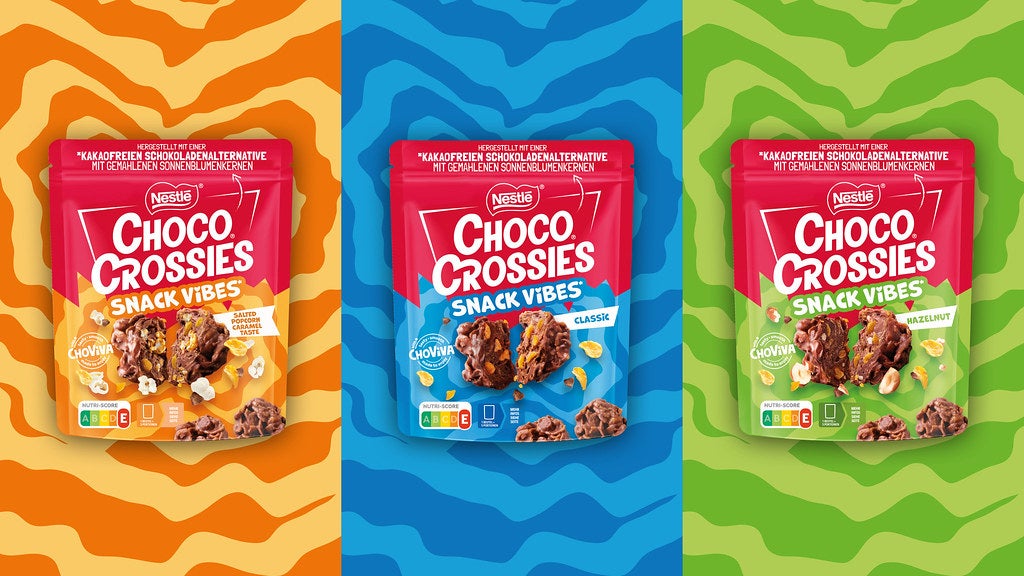
Choco Crossies Snack Vibes are made up of 74% ChoViva and 26% cornflakes, the spokesperson told Just Food, declining to say if the product will be rolled out in other markets after German retailers across the country.
Further cocoa-free products under the partnership will depend on the success of the April launch but tests have shown that ChoViva has been “well received, especially by younger target groups like Gen Z”, the spokesperson adds.
According to Planet A Foods, its ChoViva alternative is featured in around 120 products in ten countries.
Planet A Foods entered into a partnership with Barry Callebaut in November to promote cocoa-free alternatives. Christian Hansen, the head of global strategy at Barry Callebaut, said at the time the company was “embracing technology to open further avenues for growth while enhancing our resiliency to today’s cocoa-market volatility”.
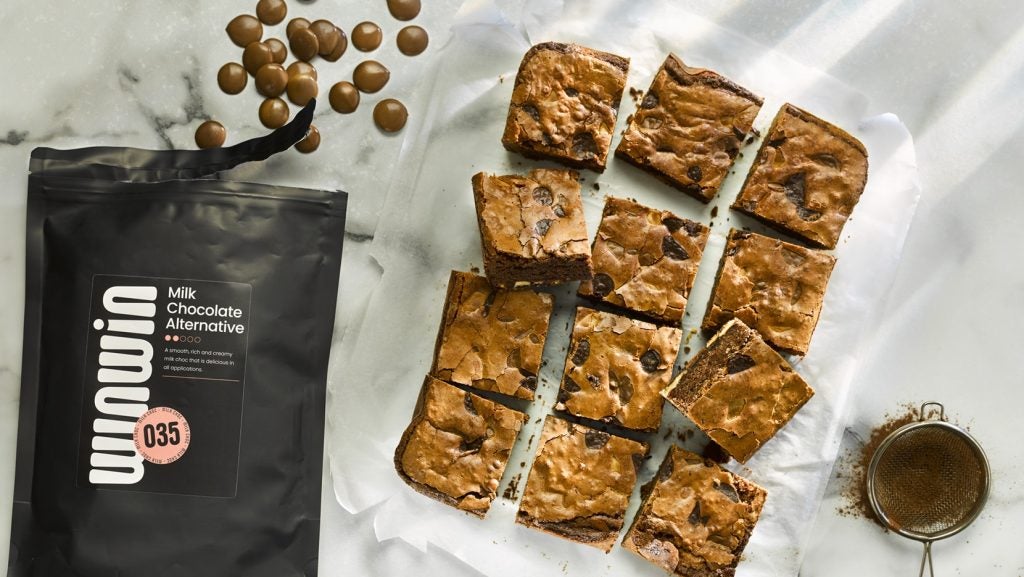
Win-Win, a UK-based food-tech company, makes cocoa-free chocolate from ingredients such as rice, carob, sunflower seeds and tigernuts. The fledgling firm says it is experiencing the strongest demand in bakery and confectionery applications including melted, baked, frozen and inclusion formats.
In 2025, Win-Win closed a £3m ($4m) Series A funding round, CEO and co-founder Ahrum Pak says was a “pivotal moment” for the business. The backing, which including from food majors Oetker Collection and Paulig, enables production “at industrial scale to meet customers’ demand”, Pak explains.
Oetker Collection bakery subsidiary Martin Braun uses Win-Win’s ingredients in products it sells customers in Germany, Austria and Switzerland, touting the cocoa-free chocolate as a “genuine alternative to conventional chocolate”, adding: “Alongside ethical and ecological aspects, changing customer awareness and rising raw material prices make these products particularly attractive.”
Earlier this month, Win-Win announced a tie-up with a wholesaler supplier in its domestic market, Keylink, to, Pak says, “bring cocoa-free chocolate alternatives to bakers and chocolatiers in the UK amid supply volatility and sustainability pressures”.
Newcomers continue to enter
Cargill and Win-Win anticipate the earliest adopters of their products to be Germany and the UK, home to large proportions of chocolate-loving and environmentally-aware consumers. Mertens-Hoyng adds that the interest in Germany, “traditionally a more conservative chocolate market”, suggests “the potential [for cocoa-free chocolate] is not confined to innovation-led markets alone. We are seeing interest in both in progressive retail environments and in more traditional chocolate cultures”.
And newcomers are entering the market. One is Belfast-based startup Born Maverick. Founder and director Azhar Murtuza says the firm’s cocoa alternative, Betta Choc, “has moved beyond early concept validation and is now in structured commercial development” following multiple trials across various categories including bakery, confectionery and dairy.
Betta Choc is made with what Murtuza calls “wasted” date seeds to create “a high-value, functional ingredient”. It is, he adds, “the world’s first cocoa alternative naturally containing theobromine”, which is found in conventional chocolate.
“Betta Choc is primarily being positioned as a B2B ingredient platform rather than a finished consumer chocolate brand at this stage,” Murtuza says.
The ingredient is being produced as a functional cocoa-alternative powder that can be supplied to food manufacturers for integration into their own products, such as cereals and ice creams. Murtuza expects early traction within bakery, snacks and beverage products.
“Betta Choc is being developed as a sustainable, fermentation-enabled ingredient that can partially replace cocoa in a wide range of applications, improving cost stability and supply resilience while maintaining indulgence,” he said. “Over time, as performance continues to improve, greater replacement may be possible. But our immediate focus is on practical integration that allows consumers to continue enjoying chocolate experiences without feeling pressure from price volatility.”
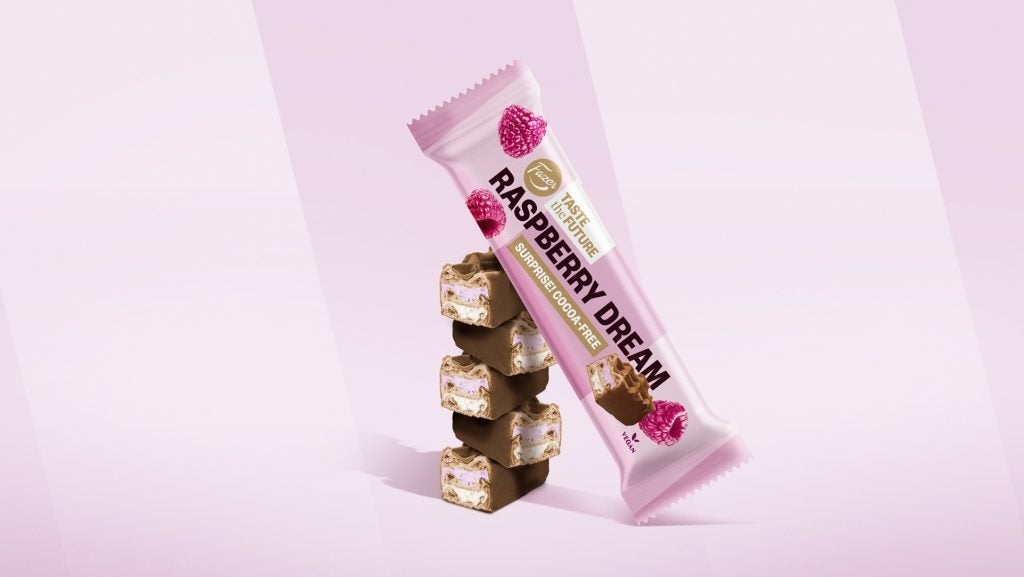
There is some movement further down the supply chain. Finland-based food major Fazer has re-released its cocoa-free Taste the Future Raspberry Dream wafer bar after the first production batch sold out last year. The bar will now be produced in “significantly larger quantities” and will be sold in all major retail stores across Finland, as well as through Fazer’s online shop.
The bar, which uses malted rye to create a roasted cocoa-like flavour, is an example of Fazer’s efforts “to create entirely new kinds of products for future generations — without compromising on taste or texture”, says Heli Anttila, VP for product and development within Fazer’s confectionery business.
“Our goal is to build sustainable food solutions so that chocolate and other treats can continue to be enjoyed even in changing future conditions,” she adds, noting the increasing threat that climate change poses to the availability of raw materials, particularly in cocoa-growing regions. To that end, replacing cocoa with a grain-based raw material is not Fazer’s “only pathway”, the company says, with the group “also exploring additional technologies that could support the future of cocoa”.
It’s important to underline that cocoa-free alternatives have so far made limited headway in the overall chocolate market.
Overall, the product area remains in its early stages but companies are gaining footholds in certain markets and executives doing business in the fledgling sector are upbeat.
“Cocoa-free chocolate has enormous potential to become a mainstream product as the cocoa supply is going to struggle to fill the demand for chocolate over the next few years,” Pak says.
The prize on offer is substantial. In 2024, the global chocolate market was worth more than $120bn, according to GlobalData figures. The data and analytics group forecasts that will grow to more than $141bn by 2029, which represents a CAGR of 3.3%.
The question is whether cocoa-free alternatives can compare with the taste and texture of conventional chocolate as that will go a long way to determining how much of that pie these up-and-coming businesses can grab.
However, the investment some of the world’s cocoa and chocolate majors have made in the nascent sector suggest there is a belief in the promise of the ingredients.
Additional reporting from Simon Harvey.
This article originally appeared in the February 2026 edition of Just Food’s quarterly digital magazine.



