

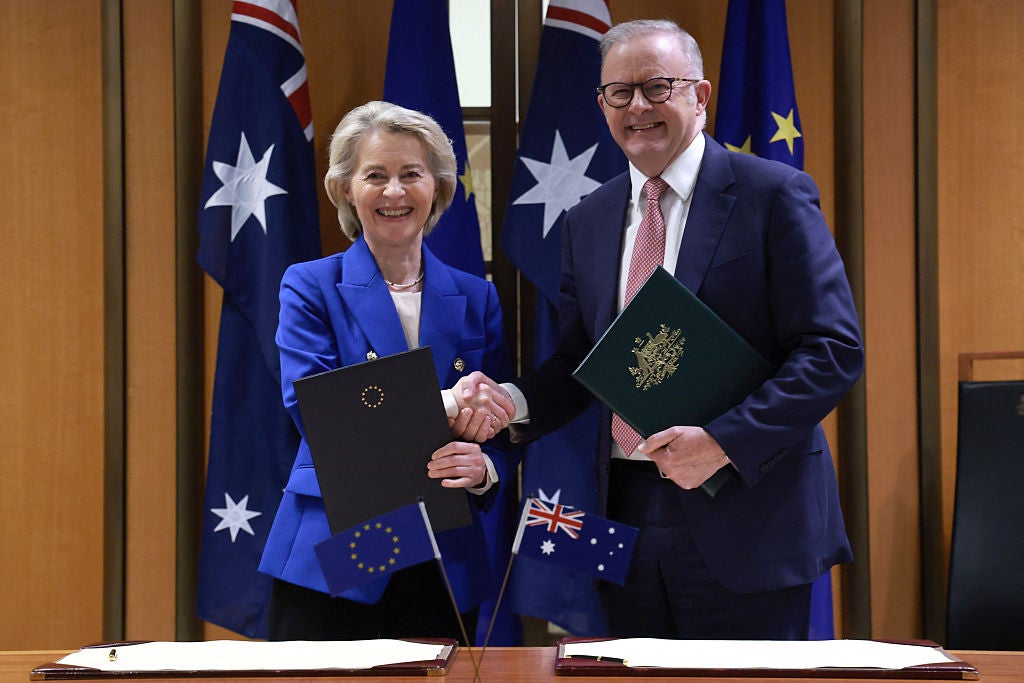
The EU and Australia today (24 March) touted the opportunities of a new trade deal that has sparked a mixed response across the food and drinks industry.
Brussels and Canberra have concluded negotiations on a free-trade agreement that will remove tariff barriers on a range of food and drinks, while protecting what the EU labelled as “sensitive” areas such as meat.
In a statement, the European Commission said tariffs on EU exports of cheese, meat “preparations”, wine and sparkling wine, some fruits and vegetables, chocolate, and sugar confectionery will be eliminated once the agreement is signed off.
Meanwhile, the Australian government said just shy of 95% of the value of the country’s agricultural exports to the bloc will enter the EU duty-free.
However, farming groups in the EU and Australia criticised the deal.
EU farming lobby group Copa-Cogeca said the agreement “raises multiple and strong concerns for European agriculture”.
Meanwhile, The Australian Meat Industry Council said it “voiced strong disappointment” over the outcome of the deal, arguing it “entrenches restrictive access for red meat and places Australian producers at a competitive disadvantage in the European market”.
Under the terms of the deal, Australia exporters of products “such as beef, sheep and goat meat, sugar, some dairy products and rice” will only be able to sell at zero or at reduced tariffs “in limited amounts”, the European Commission said.
These quotas will apply to most dairy products including cheese, butter and skimmed milk powder, according to the statement from the Australian government. Beef, sheep meat, wheat gluten and ethanol also feature on the quota list, along with milled and semi-milled rice.
The European Dairy Association welcomed the agreement, which it said will “help bolster the competitiveness and resilience of European industries, including the dairy sector”.
Eurolait added EU exporters shipped almost €400m ($463.7m) worth of dairy products to Australia last year, with cheese topping the list followed by butter, milk powders and infant formula.
However, Copa-Cogeca, pointing to beef, sheep meat, sugar and rice, labelled the quotas “significant concessions”.
It added: “In a post-Mercosur context, the cumulative impact of successive trade agreements makes these concessions unacceptable. Even for a traditionally more offensive sector like wine, the potential benefits of this agreement remain elusive, with Australian exporters likely to see more benefits due to the elimination of duties.”
Geographical Indications protections will be implemented on 165 food and agricultural products as part of the agreement, which comes after eight years of negotiations.
The EU and Australia have also agreed on a “modernised bilateral wine agreement”, which will provide protection for all EU wine GIs covering 1,650 names, including the addition of 50 new wine GIs from 12 of its member states.
Trade body Australia Grape & Wine welcomed “elements” of the deal, pointing to the removal of tariffs on wine exports to the EU. Europe, the organisation said, is the largest market for Australia wine. However, it noted Australian producers of Prosecco will no longer be able to export their wine to the EU after a ten-year phase-out period.
Meanwhile, SpiritsEurope, the organisation representing distillers in the EU, said Australia’s move to eliminate tariffs on spirits from the bloc “represent an overdue improvement in market access”.
Australia suggested it could take up to two years for the agreement to come into force. As part of the legislative process, the European Council and Parliament now have to give the all-clear to the trade deal before the EU and Australia can officially complete the agreement and make it live.
“With the conclusion of negotiations for an ambitious and balanced free-trade agreement, the EU is opening the market to one of the world's fastest-growing developed economies and thereby bringing significant economic opportunities to European companies, consumers and farmers,” the European Commission said.
Australia Prime Minister Anthony Albanese added the deal “creates major new opportunities for Australian exporters in the European Union’s massive A$30trn [$20.9trn] economy and will reduce costs for Australian consumers”.
The EU said the trade deal features a “bilateral safeguard mechanism”. That, the bloc added, will allow the EU to “take measures to protect sensitive European products and their producers in the unlikely event of a surge in imports from Australia causing injury to the EU market”.
It explained: “As an additional layer of protection for farmers, the bilateral safeguard mechanism will be operationalised in a self-standing EU regulation that will see swift and effective protections kick into gear, in the unlikely event of an unforeseen and harmful surge in imports or an undue decrease in prices for EU producers.”
Copa-Cogeca countered: “For now, such mechanisms proposed by the Commission remain more like communication tools to promote hardly acceptable agreements than truly effective mechanisms that can be activated in the event of a crisis.”