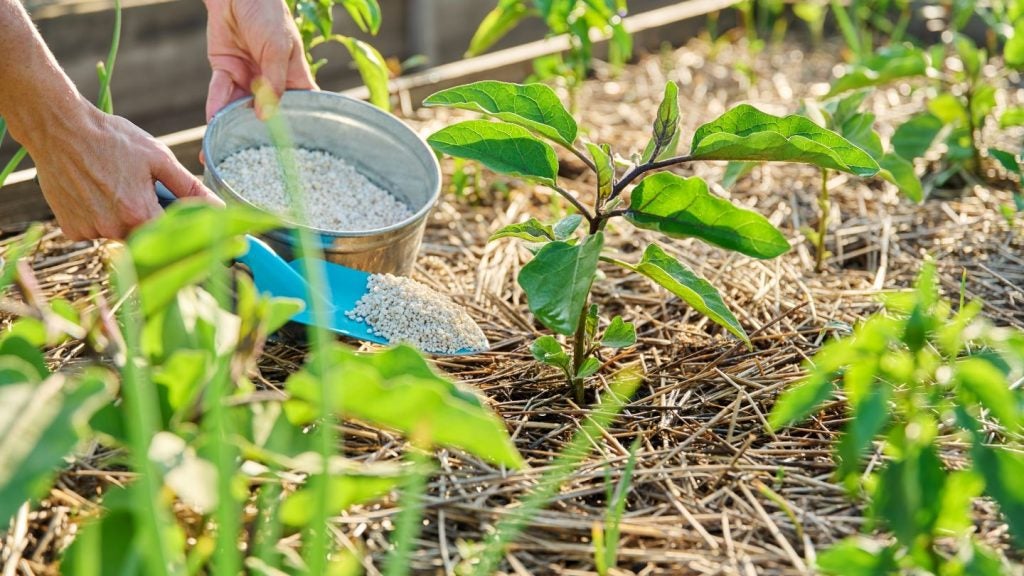
The EU has suspended customs duties on key nitrogen-based fertilisers for a year, aiming to ease cost pressures for farmers amid the global supply disruptions.
Approved by the European Council, the measure covers "essential" inputs like urea and ammonia, temporarily lifting standard tariffs that range between 5.5% and 6.5%.
The European Commission estimates the waiver will save importers approximately €60m ($69.8m) in duties.
“It will also reduce the EU's dependency on Russia and Belarus for fertiliser products and help build a more diversified trading network in this area”, the Council said in a statement on Friday (22 May).
The EU has structured the tariff suspension with volume caps.
According to the Council, the relief applies only to products not already entering the EU duty-free under the most-favoured-nation (MFN) provisions.
“However, to balance the interests of EU producers, the measure is limited to a quota of goods equal to the volume of MFN imports in 2024 plus 20% of the volumes imported from Russia and Belarus in the same year.”
The suspension explicitly excludes imports from Russia and Belarus due to the war against Ukraine.
"The EU has decided that the suspension will not apply to products imported from Russia due to its unprovoked and unjustified war of aggression against Ukraine," the Council explained.
"Nor will it apply to products imported from Belarus given its support for Russia, and its disregard for international law, fundamental freedoms and human rights."
The waiver will take effect the day after its publication in the EU’s official journal. The Commission will monitor developments to propose extensions or modifications if required.
In 2024, the EU imported two million tonnes of ammonia, 5.9 million tonnes of urea, and 6.7 million tonnes of nitrogen-based mixtures, according to the statement.
The decision comes against the backdrop of a supply shock caused by the near-total closure of the Strait of Hormuz due to the Iran conflict.
The disruption of the maritime route, which handles roughly one-third of the global fertiliser trade, has triggered international price spikes.
On 20 May, the United Nation’s Food and Agriculture Organization (FAO) warned the shipping bottleneck is shifting into a “systemic global agri-food crisis”, with food price shocks expected within six to 12 months.
Reflecting these pressures, the FAO Food Price Index rose for a third consecutive month in April, driven by high energy costs and Middle East conflict disruptions.
The tariff suspension follows the Fertilizer Action Plan adopted by the European Commission on 19 May to insulate European food security from geopolitical crises and volatile market shifts.
The newly deployed action plan provides liquidity relief for farmers, such as bolstering the EU agricultural reserve and introducing flexible cash flow rules under the Common Agricultural Policy.
Over the coming years, the Commission intends to reduce its reliance on foreign agricultural inputs by expanding domestic manufacturing, accelerating the commercial adoption of sustainable fertiliser alternatives, and launching the EU Fertilizers Value Chain Partnership to enforce transparency.