

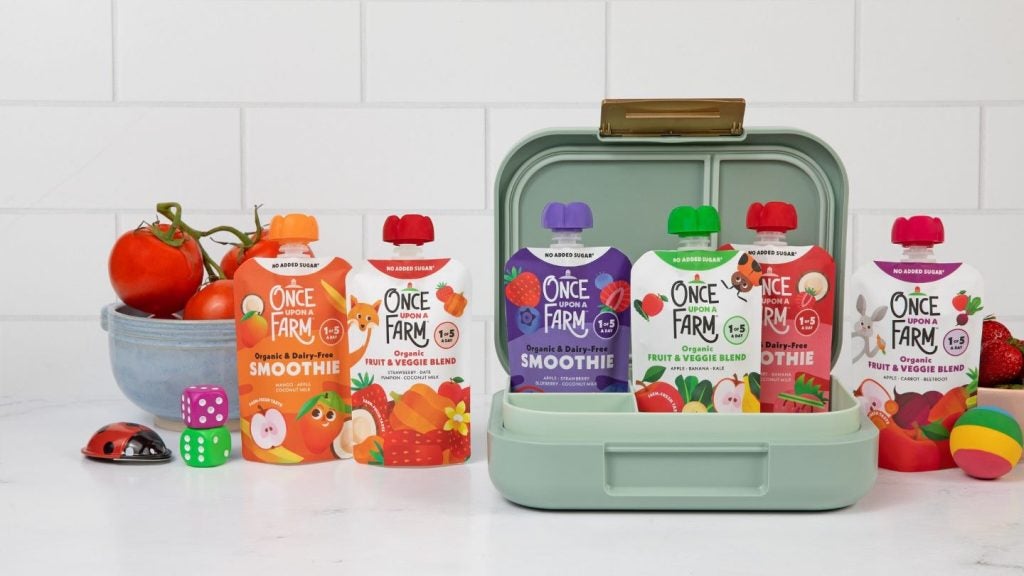
Fresh from an IPO, organic baby-food business Once Upon a Farm is leaning on new cooler placements in retailers to drive volume-led growth in 2026.
California-based Once Upon a Farm, which raised around $139m when it went public in New York in February, plans to increase the number of coolers to 5,000 from 3,400 in 2025.
That should help boost sales in the baby-food segment of the business. Those sales increased 62.2% in the fourth quarter to $29.3m, driven by 35.8% growth in pouches and 91.3% in snacks.
In value terms, the kids’ sector for the company is larger but with less significant growth. Those sales rose 11.5% to $34.7m amid a 9.8% rise in pouches and 25.8% in snacks.
Discussing the fourth-quarter and annual results with analysts yesterday (12 March), co-founder and CEO John Foraker acknowledged Once Upon a Farm has some way go to in catching up with competitors.
As group sales climbed 53.5% for the year to $240.7m, Foraker noted that while household penetration increased 42% last year to 5.1%, it still lags behind its peers.
“While this growth trajectory is encouraging, we recognise substantial runway remains when we consider that leading competitors average 12.5% household penetration or higher.
“Over time, we see mid-teens or higher household penetration as we continue to build brand awareness and broaden our product portfolio to increase the number of consumer-relevant categories where we show up.”
New products are set to come on stream to complement the USDA-certified organic fresh food, snacking pouches and dry baby snacks portfolio, which are all no added sugar, with no preservatives or artificial flavourings.
Meat and bone broth, and legume blends will be introduced in April.
“One of the key consumer requests that we’ve gotten for a long time, just like every other consumer packaged goods company in America, is for more protein and better protein,” Foraker said.
He outlined the threat from an unnamed competitor as the CEO emphasised volume-driven growth in 2026 as a key element, although Foraker suggested that threat comes from dairy.
“We’ve been in the kid dairy set for a long time. It’s a very competitive space. The only significant change in competitive set over the last year or so has been a new entrant that came into a big mass account of ours, into our section, in about September,” he explained.
“We’ve been going head-to-head there for about six months. As you could expect, they came in pretty aggressively and have done over 50% of their volume on deal since the beginning, plus marketing investments and customer support, including retailer-supported display at launch.
“Despite all that, our average dollar velocity per week on our items is two times better than that competitor.”
In general terms, Foraker said Once Upon a Farm can hold its own on price despite its premium positioning.
“We are priced very competitively relative to the value we’re providing for consumers, and that they see,” he told analysts yesterday during a Q&A round.
“We’re definitely a premium product but consumers see a lot of value in it, and we feel like our price gaps are in a really good spot.”
Once Upon a Farm, which has tipped its toe into the UK market this year, expects sales to grow in value terms in 2026 but at a slower growth pace. Sales are forecast at $302-310m, an increase of 25-29% over 2025.
Adjusted EBITDA is expected to be around the same level as last year’s $2.1m, which represented a rebound from a $3.7m loss in the corresponding period. One Upon a Farm envisages a print of $2-4m.
No estimate was provided for net income, which narrowed losses last year to $17.2m from $23.8m.
There is likely to be further pressure on the gross margin, mainly due to the introduction of new coolers and to a lesser extent tariffs.
The margin dropped 125 basis points last year to 42.3% and is expected to retreat by another 120 points in 2026, Foraker said.
“The driver of that is coolers. We’re projecting higher cooler slotting than ‘25 but we’re also building in about 100 basis points of tariff costs during the year. Between both of those, that’s what’s impacting margin right now,” he added.