


Industrial decarbonisation is speeding up in France as manufacturers turn to energy efficiency upgrades, electrification, renewables, and waste heat recovery as a way of lowering energy costs and reducing their exposure to oil and gas volatility. This shift also supports aggressive CO2-reduction targets outlined in the country’s latest Multi-Year Energy Plan, which aims for carbon neutrality in France by 2050.
From some of the country’s largest polluters replacing carbon-intensive steelmaking infrastructure with electric furnaces, to aerospace and automotive manufacturers deploying industrial biomass heating boilers, companies are moving beyond efficiency-only measures and initiating deep decarbonisation projects.
According to Charles Huguet, Industry Development Manager at E.ON Energy Infrastructure Solutions, France’s unique grid dynamics place companies in a strong position in terms of electricity supply: “France is seen as one of the most interesting countries in Europe, dealing with robust energy infrastructure plus decarbonised electricity supply,” he says.
In 2024, 96.2% of electricity generated in France was decarbonised.[i] At least 68% of this was produced by the country’s impressive nuclear power fleet, which provides reliable, low-carbon electricity that can replace natural gas or oil in heavy industry applications.
Why French manufacturers are going electric
Switching out fossil fuels for electricity can bring financial benefits, too. While electricity may cost more per MWh, it is often more efficient to use. For example, heat pumps can deliver 3 or 4 units of heat energy for every 1 unit of electricity they consume.
Embracing electrification can also allow companies to turn their energy consumption from a fixed operating cost into a flexible, revenue-generating asset. This flexibility can be offered to the local transmission system operator in France, RTE, which runs daily grid balancing mechanisms to procure energy reserve capacity in return for financial compensation.
“Since 2024, this has been very remunerative in France,” says Huguet. “Any time manufacturers can justify that they can either consume or switch off electrical consumption in real-time, they can generate a lot of revenues on an annual appreciation.”
Funding decarbonisation projects in France
Across Europe, public support has become a major enabler, helping manufacturers overcome the high upfront investment costs and financial risks associated with adopting low-carbon technologies such as electric boilers, heat pumps, and on-site renewables. Recently, the European Commission announced that the Innovation Fund 2026 (IF26) Heat Auction will launch in December 2026, offering a budget of $1 billion to support industrial heat decarbonisation projects.
Private finance models have also become a “mandatory” piece of the puzzle, says Huguet. These involve contracting with specialised energy infrastructure companies that build and finance the new energy assets on behalf of the industrial manufacturer. Such partnerships prevent the client from bearing the infrastructure investment on their own balance sheet, protecting debt ratios and allowing them to focus investments on core operations.
“E.ON Energy Infrastructure Solutions (EIS) is one of the pioneers of this model in Europe,” Huguet adds. “We’ve been doing this for more than 15 years and are one of the most efficient companies in contract structuration.”
The value of such partnerships goes far beyond financials. Taking responsibility for the complete project lifecycle, energy transition experts at E.ON develop, design, implement, operate, and optimise the entire system for the customer, combining deep technical expertise with strong knowledge of the local infrastructure and regulatory framework to deliver the most optimal, cost-effective solution.
The resulting projects feature highly integrated systems that are fully customised to the client’s unique energy situation, often incorporating a variety of on-site renewable options alongside waste heat recovery or even district heating network integration.
E.ON is currently developing France’s first-ever Ectogrid integrated heating and cooling network in the Magasins Généraux district of Reims. With this solution, energy will be exchanged between urban buildings, allowing heating and cooling demand to be optimised across the district. Surface geothermal energy, heat pumps, rooftop solar PV, and thermal storage will complete the solution.
In Seingbouse, north-eastern France, E.ON partnered with AGC Glass to install both an 8 MW photovoltaic power plant on AGC’s premises and an innovative 1.3 MW Organic Rankine Cycle (ORC) system which generates electricity from the significant amount of heat previously lost in the plant’s flue gas. These solutions provide the facility with approximately 15 gigawatt-hours of decarbonised electricity every year, covering a large portion of the plant’s total requirements.
It starts with energy efficiency
All projects begin with a complete energy audit of the plant. After this, E.ON identifies where the facility consumes, emits, and wastes energy, and can then propose a new architecture that makes processes more efficient and less fossil fuel dependent. As a first step, energy efficiency upgrades can go a long way in reducing a plant’s consumption, as shown by various reference projects with ArcelorMittal – one of the world’s leading steel and mining companies.
ArcelorMittal commenced its partnership with E.ON in 2016 with the goal of lowering energy usage and CO2 emissions while minimising disruption to production. Work started with lighting, where LED solutions offered attractive savings. Since 2016, the partnership has expanded into approximately 30 projects across five to six French sites, incorporating heat recovery, HVAC upgrades, variable-speed drives, and other technologies.
Overall results include natural gas savings of 16 gigawatt-hours per year (GWh/a) and guaranteed power savings of 8.2 GWh/a.
Download the new report
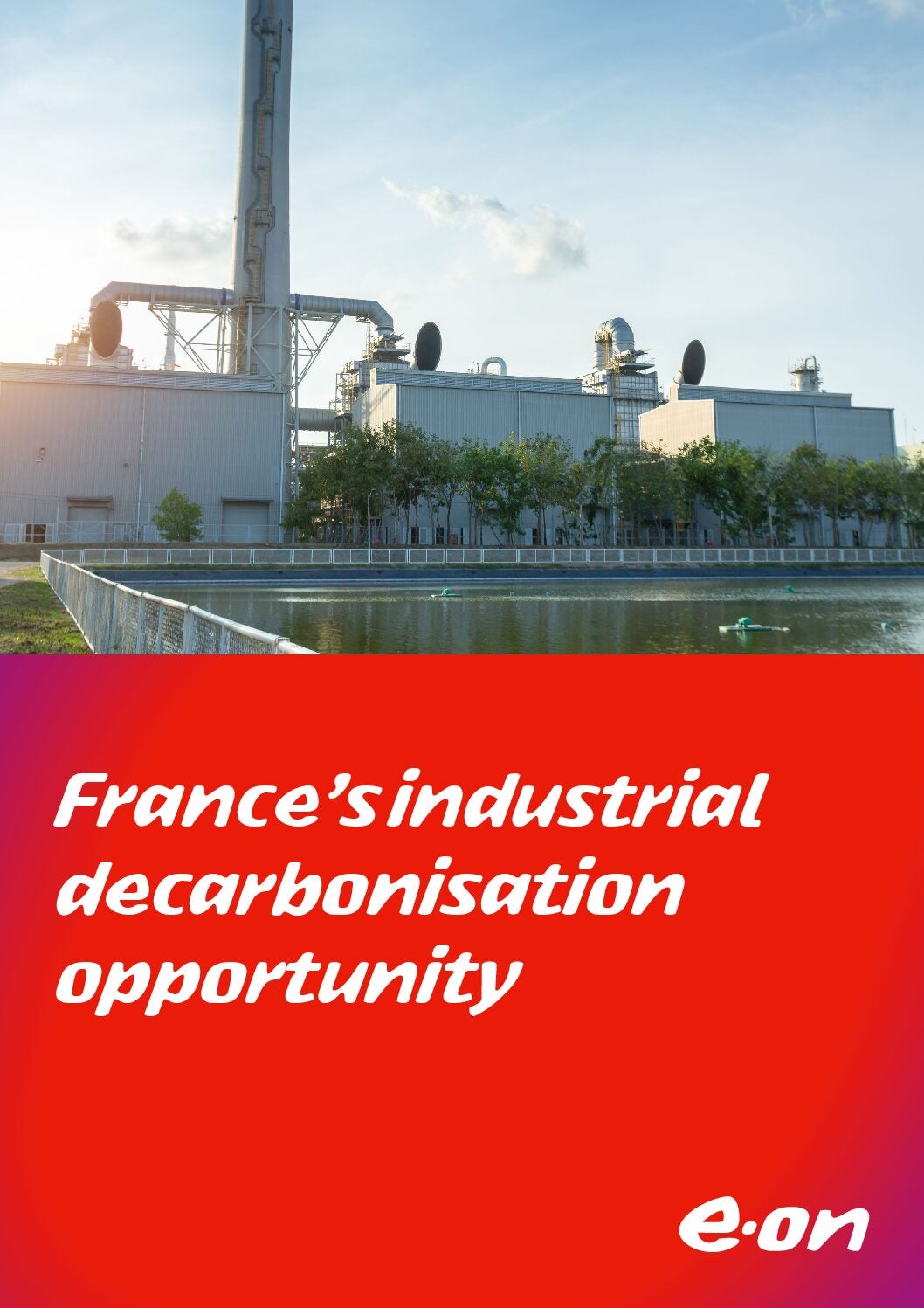
In a new report, E.ON unpacks the full energy transition opportunity for France’s industrial players, from flexible energy models to public funding possibilities and third-party financing. Download below to discover practical, cost-effective routes to strengthening energy resilience in France and turning electrification and decarbonisation into a long-term competitive advantage.
[i] https://welcome.businessfrance.fr/en/why-choose-france/france-key-strengths/competitive-and-carbon-free-energy/
