

Major US food companies are starting to reduce prices and increase promotional activity after several years of sustained price increases. At first glance, this may look like a strategic pivot. It is not.
The shift is visible across major players, including PepsiCo, General Mills, Kraft Heinz, Conagra Brands and JM Smucker, but what’s unfolding is continued pressure from a more competitive and structurally more price-sensitive US grocery environment.
Go deeper with GlobalData


Access deeper industry intelligence
Experience unmatched clarity with a single platform that combines unique data, AI, and human expertise.
As I noted in this 2024 column, early signs of consumer resistance in the US were already emerging, as repeated price increases began to accelerate moves by shoppers to trade down in key categories. At the time, the signal was uneven and still forming. What has changed since then is not direction but density. The pressure is now consistent across categories, retailers and consumer income segments.
Taken together, these developments suggest that pricing power in the US food and beverage sector proved more constrained than had been assumed during the inflationary cycle. Price increases supported revenue growth for a period but they also revealed elasticity that was structurally present all along and which only became visible as pricing accumulated across everyday categories.
Between roughly 2021 and 2023, pricing became the primary growth engine for US food and beverage companies, particularly the majors. As input costs rose sharply across commodities, logistics and labour, companies leaned heavily into price increases to protect margins and sustain reported revenue growth.
For a time, it worked. Consumers absorbed higher prices without an immediate break in demand. That resilience was supported by pandemic-era savings buffers, stimulus effects and shifting consumption toward at-home eating. Price/mix became the dominant driver of growth across portfolios, often masking underlying softness in unit volume. Pricing power appeared broad, transferable and structurally dependable.
But that reading was incomplete. It assumed stability in demand that was conditional on an inflation environment that could not persist indefinitely at that intensity. Once price increases accumulated across categories, consumer behaviour began to shift in a more consistent direction. Not abruptly but steadily.
Trading down increased. Basket sizes shrunk. Promotional sensitivity rose. Retailers reinforced these dynamics by strengthening their private labels and expanding value tiers within categories, making substitution easier and more visible at shelf level. Importantly, retail trade funds and temporary price reductions became a larger share of actual consumer price realisation, meaning effective pricing began to diverge more meaningfully from list price strategy.
The adjustment did not arrive as a single inflection point. It built gradually, then hardened into pattern. Consumer resistance in key US grocery categories had moved beyond a short-term inflation response to a sustained value recalibration. Private label adoption accelerated, particularly in staples and centre-store categories where perceived differentiation between branded and store-brand products had narrowed. In many cases, retailer brands became embedded as the first-choice option in household purchasing, not just the backup alternative.
The combined effect is a narrowing of the strategic space available to legacy brands in the US.
At the same time, a second structural shift was unfolding on the other end of the market. Emerging brands continued to gain traction by competing on attributes legacy companies struggle to scale within existing cost structures. These included functional benefits, ingredient transparency, premiumisation and more explicit brand identity tied to lifestyle and usage occasions.
Importantly, these smaller brands were not competing on price. They were competing outside the legacy pricing framework entirely. They expanded the definition of what consumers consider a credible alternative, which is ultimately more consequential than direct substitution.
The combined effect is a narrowing of the strategic space available to legacy brands in the US. Private label has strengthened its role as a permanent value anchor rather than a cyclical substitute, with retailers now actively managing category mix in favour of owned brands where velocity is stable. Emerging brands have expanded the premium ceiling by fragmenting demand at the higher end of the market. What sits between those two forces – the traditional centre-of-store positioning – is structurally more constrained than it was even a few years ago.
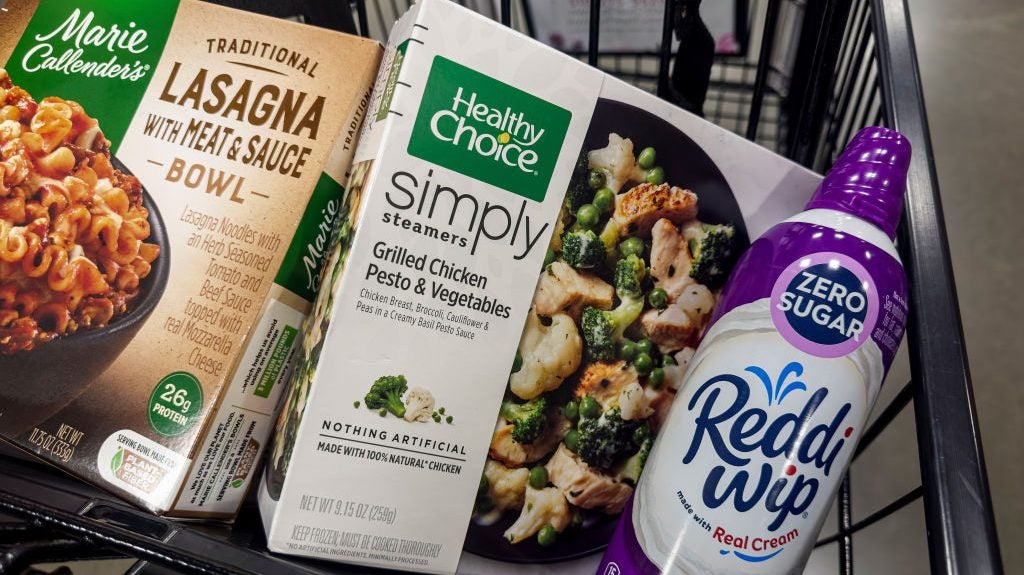
Against that backdrop, the current pricing adjustments by companies like Conagra, General Mills and PepsiCo should be read for what they are: tactical responses to volume pressure and elasticity shifts, not a coordinated strategic reset.
In practice, these adjustments are uneven. In some categories, they show up as increased promotional intensity. Elsewhere, they are selective price repositioning where elasticity has proven more pronounced. Increasingly, they are expressed through packaging architecture, entry price reinforcement and SKU optimisation designed to protect velocity rather than restore pricing power.
Retailers are a critical part of this dynamic. Trade funds, feature space and temporary price reductions are now doing more of the work once attributed to list price strategy. In effect, effective pricing is being negotiated in real time at shelf level rather than set upstream through brand strategy alone. This shifts power further toward retail execution and away from manufacturer-led pricing discipline.
The intent of the legacy brands is straightforward. Stabilise volume. Defend shelf space. Slow share erosion in categories where switching has become easier and private-label penetration has structurally increased.
Consumers have recalibrated their reference points for value
In the near term, these moves will likely achieve partial stabilisation. That is not in question. The issue is what they do not address.
The core challenge is not simply that prices rose too far or too quickly. It is that pricing was used as a substitute for differentiation during a period when demand conditions temporarily allowed it to function as the primary growth lever. That substitution worked until it didn’t. And once it stopped working uniformly across categories, the structural limits became visible.
Now the environment has shifted. Consumers have recalibrated their reference points for value. Retailers have strengthened private label as a permanent fixture of assortment strategy. And emerging brands have expanded the range of credible alternatives across multiple tiers of the market.
In that context, price reductions and promotions may recover some volume at the margin but they do not restore the structural advantage that once supported sustained pricing power.
This is the more important distinction. Pricing is no longer operating as a source of competitive advantage in the way it did. It is increasingly operating as a response mechanism used to manage demand rather than define it.
The question for legacy companies is not whether these adjustments stabilise near-term results. They likely will, at least partially. The question is what they reveal about the underlying structure of the US grocery market.
Legacy brands are operating in an environment where private label has permanently elevated its position as a value anchor, while emerging brands have permanently expanded the definition of premium. That combination structurally reduces the room for pricing to function as a growth strategy in the way it did during the prior cycle.
The implication is not that pricing stops mattering. It is that pricing can no longer be treated as a primary lever of competitive advantage. For legacy brands, the more durable response is not incremental price adjustment but a reset in how differentiation is built across innovation, brand positioning and value architecture. In practical terms, pricing can defend position but it cannot define it anymore.
And once pricing shifts from a lever of expansion to a tool of defense, it signals something more durable than a cycle adjustment. It signals a structural repositioning of where value is created, how it is defended and where it is increasingly lost.
In today’s US grocery environment, pricing can still manage pressure but it can no longer define advantage. Tactics like pricing adjustments and promotional intensity may stabilise near-term performance but they are not a substitute for strategy. And increasingly, that is the gap legacy brands are now operating within.


