

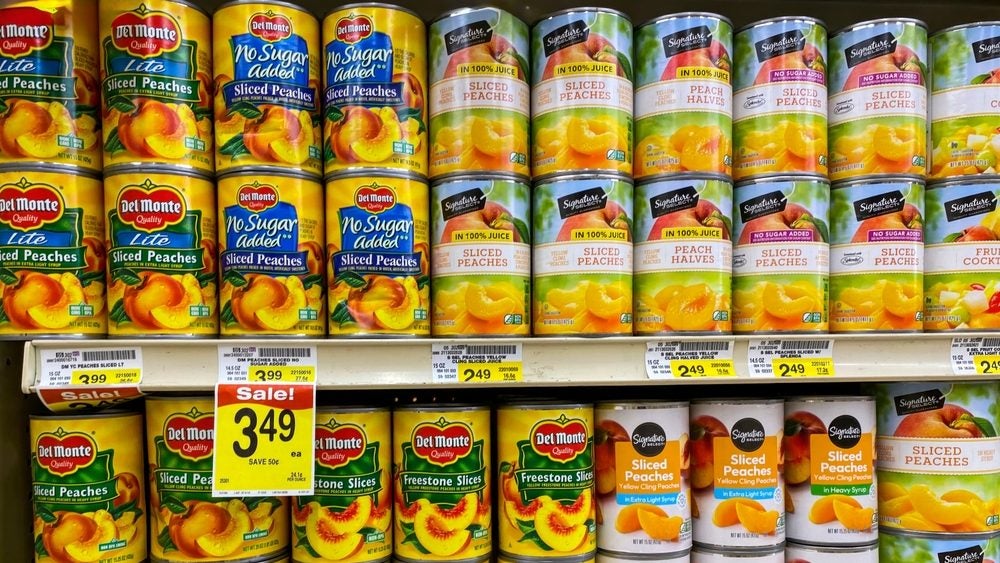
For years, the canned fruit category in the US has been in steady decline. Consumption has gradually eroded, shelf space has narrowed and the category has lost relevance in a retail food system increasingly oriented around fresh, refrigerated and perceived less-processed options.
There is nothing particularly unusual about that. Retail food categories can operate in a state of slow, managed decline for extended periods of time. Volumes soften, weaker players exit, stronger ones consolidate and the system adjusts. The category becomes smaller, but it continues to function.
The industry built around canned fruit has, until recently, largely followed that pattern. Processing capacity remained in place, grower networks held together and the supply chain, while under pressure, continued to operate with a degree of stability. Even as demand declined, the underlying structure of the category remained intact.
That balance is now shifting.
Structural shift
The issue is no longer just the trajectory of the category. It is that the industry behind it is beginning to contract as well. And when both start to move in the same direction, the dynamics change.
Canned fruit is not simply a set of products on a grocery store shelf. It is a system built around specialised crops, regional growing networks and large-scale processing capacity.
Cling peaches (the variety used for commercial canning in the US), pears and other processing fruit are not widely interchangeable with fresh markets. They are grown for canning, often under contract, and depend on the presence of nearby processing facilities capable of handling large volumes in a short harvest window.
As long as that system remains intact, the category can absorb declining demand. Once parts of it begin to disappear – like is happening right now in real time in California where the vast majority of the nation’s canned fruit is grown and processed – the decline does not remain gradual.
What is emerging now is a shift from demand-driven erosion to structural contraction.
Recent developments across the industry reflect that shift. The restructuring of major processors, including Del Monte Foods, and the closure of processing facilities in California, point to a more fundamental change taking place.
The shutdown of the massive Modesto, California Del Monte Foods’ plant is a clear example. Facilities of its scale are not easily replaced, and in many cases are not replaced at all. When they exit the system, they take with them not only capacity, but the grower relationships, logistics networks and regional infrastructure that support them.
For growers, the loss is immediate and practical. Processing fruit has fewer alternative markets and without a nearby cannery, the economics of maintaining those orchards change quickly.
(For example, California cling peach growers are facing over $550m in revenue losses following the closure of Del Monte Foods’ Modesto plant. Del Monte voided 20-year contracts for many farmers, leaving roughly 50,000 tons of fruit without a buyer, prompting calls for emergency federal aid and potential orchard removals. California grows nearly 100% of the country’s cling peaches.)
That is where the category begins to encounter a different set of constraints.
Supply chain reshaping
For much of its history, canned fruit operated within a relatively stable system. Production was aligned with processing capacity and processing capacity was aligned with retail demand. Even as volumes declined, that alignment could be maintained through consolidation and incremental adjustment.
What is happening now suggests that alignment is becoming more difficult to sustain.
As demand continues to weaken, processors face increasing pressure on utilisation rates and margins. Large-scale facilities require throughput to remain economically viable. When volumes fall below certain thresholds, the options narrow – invest to modernise, attempt to consolidate additional volume or exit capacity are generally the only viable options. Increasingly, the industry appears to be choosing the latter.
That, in turn, has consequences that extend beyond individual companies.
When a processing facility closes, it does not simply reduce output. It reshapes the supply chain around it. Growers lose a buyer. Hauling distances increase for those who remain. Harvest timing becomes more constrained. Risk increases across the system. Over time, some growers exit the category entirely, removing supply that cannot easily be replaced.
The result is a system that becomes smaller, but also less flexible.
This is where the dynamic begins to change. Declining demand leads to reduced capacity. Reduced capacity leads to a smaller and less stable supply base. A less stable supply base makes the category less attractive to retailers, who are already reallocating space to faster-growing segments. That, in turn, reinforces the original decline in demand.
In other words, the category and the industry begin to move together, each reinforcing the other’s direction.
Status quo returns
The Covid-19 pandemic briefly obscured this trajectory. The surge in demand for shelf-stable foods created a temporary lift across canned categories, including fruit. For a period, it appeared (to some optimists) as though the long-term decline might stabilise or even reverse. That proved to be a false signal.
As demand normalised, the underlying structural issues re-emerged. In some cases, the temporary increase in volume may have delayed difficult decisions around capacity and investment. In others, it may have encouraged commitments that were not sustainable once conditions returned to trend. Either way, the result is that the current phase of adjustment is occurring more abruptly.
Where does this leave the category and the industry that supports it?
Canned fruit is not disappearing. It continues to serve a role in the market, particularly in value-oriented segments, institutional channels and areas where shelf life and convenience remain important. But its future is likely to look different from its past.
The category will become smaller and more concentrated. A greater share of volume will probably shift toward private label, where price sensitivity is more pronounced and brand differentiation is less critical. The number of processors is and will continue to decline, with remaining players operating at a scale and cost structure that reflects lower overall demand. Production will become more regionally concentrated, with fewer facilities serving larger areas.
Uncertain future
What is less clear is whether the system, once reduced, can stabilise at that smaller size.
That will depend in part on whether the remaining infrastructure can support a consistent and reliable supply base, and whether retailers continue to allocate space to the category at levels that justify that infrastructure. It will also depend on whether there is any meaningful reinvestment in processing capacity, either to replace what has been lost or to modernise what remains.
At the moment, there are few indications that such reinvestment is occurring at scale.
That is what makes the current phase different from earlier periods of decline. It is not simply that volumes are lower. It is that the industry is beginning to lose pieces of the system that allowed it to operate efficiently in the first place.
For food and agri-food executives, the implications extend beyond canned fruit.
Many legacy categories share similar characteristics: high fixed infrastructure costs, specialised supply chains, limited differentiation and increasing competition from formats perceived as fresher or more aligned with current consumer preferences. In those categories, as in canned fruit, long-term demand erosion can be managed for a time. The risk emerges when that erosion begins to undermine the economic viability of the infrastructure that supports the category.
That is the point at which gradual decline can give way to something more structural.
The canned fruit category in the US is approaching that point. The signs are not limited to any single company or facility, but they are visible in the broader pattern of capacity rationalisation, grower uncertainty and limited new investment.
Categories rarely disappear all at once. More often, they contract over time, losing scale, relevance and ultimately the systems that sustain them. What determines the pace and extent of that contraction is not just demand, but the resilience of the industry behind it.
In canned fruit, that resilience is now being tested. In my analysis, further decline is imminent.
The trajectory of canned fruit also offers a lesson for other legacy retail categories. Slow demand declines can be managed for years, but once the industry infrastructure supporting a category begins to contract, the pace and permanence of decline accelerate. Categories with high fixed costs, specialised supply chains or limited differentiation can face the same dynamics.
Canned fruit is more than a shrinking segment on the shelf; it shows how long-standing retail food categories can move from manageable decline into structural contraction.