
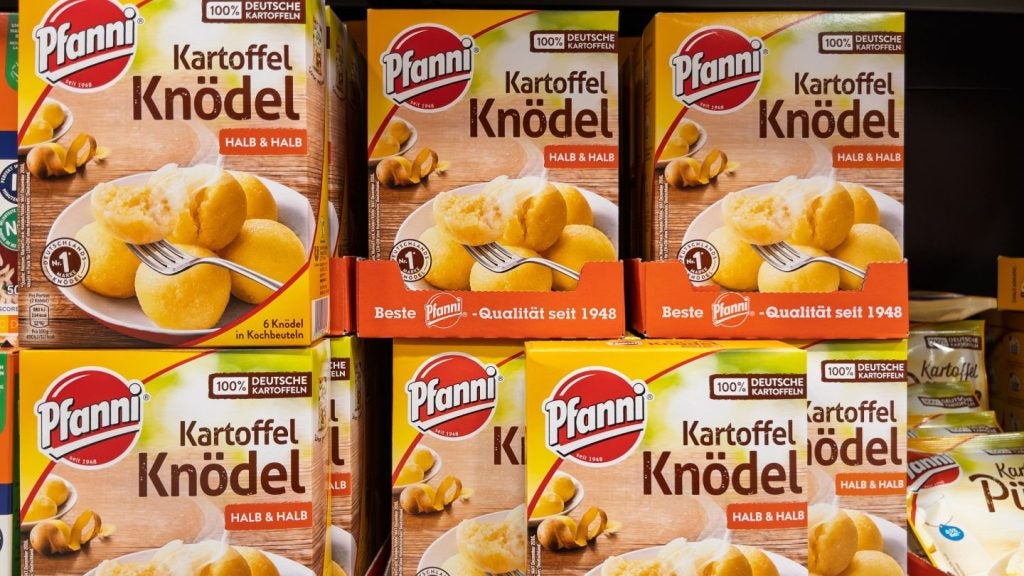
A German court has ordered Unilever to stop using the claim “from sustainable cultivation” on packaging for its Pfanni dumpling dough.
The Hamburg Regional Court’s order followed a lawsuit brought by the German Environmental Aid Association - Deutsche Umwelthilfe (DUH) - over Unilever’s Pfanni Dough for Dumplings with Raw Potatoes.
The court found the term “sustainable” was vague and carried a “particularly high risk of deception”, comparable to “climate neutral”, according to DUH.
It said companies advertising products as being from “sustainable cultivation” must specify the criteria underpinning the claim and explain how they monitor compliance.
Unilever had not provided sufficient information on the packaging, the court found, while its principles for sustainable agriculture were non-binding.
“Due to the lack of assurance of compliance, all principles for the advertised sustainable cultivation are invalidated from the outset, and thus their blanket advertising with the statement ‘from sustainable cultivation’ is misleading,” the court concluded.
In a statement sent to Just Food, Unilever said it would accept the decision.
“We respect the decision of the Hamburg Regional Court,” the UK-headquartered consumer goods group said.
“Following the cease-and-desist letter from Deutsche Umwelthilfe in September 2025, we first revised the information on our website and decided to remove the statement ‘potatoes from sustainable farming’ from our packaging.”
Unilever added: “Since May 2026, Pfanni’s dumpling dough has been supplied to retailers exclusively without this statement."
The Knorr and Hellmann’s brand owner said it had also reviewed and updated all environmental claims on its food packaging in Germany in response to new legal requirements.
Jürgen Resch, DUH federal managing director, said the ruling established minimum standards for products advertised as sustainable.
“Consumers must be able to rely on the fact that promised attributes such as ‘from sustainable cultivation’ actually meet defined standards and that compliance is monitored,” Resch said.
He also called on Unilever to phase out chemical-synthetic pesticides and switch to organic farming.
The ruling follows a separate greenwashing dispute involving New Zealand-based dairy ingredients business Fonterra.
In April, the group admitted that using “100% New Zealand” and “Grass Fed” together on Anchor butter packaging was likely to mislead some consumers because its cows’ diets included supplementary feed, including imported palm kernel.
Fonterra removed the combined claim and updated the packaging to show only “Grass-Fed”.