


Across Europe today, food and beverage (F&B) manufacturers face rising energy prices and uncertainty, as well as growing pressure to decarbonise.
The challenge for manufacturers is to cut energy costs and CO₂ emissions while keeping production running reliably. Although EU industrial electricity demand has stabilised, cost pressures persist: the European Commission forecasts inflation of 3.1% in 2026, partly reflecting the pass-through of energy costs to wider prices[i].
F&B manufacturing facilities often need heat and cooling at the same time: products must be chilled, while water and equipment are heated for cleaning, washing and pasteurisation. That can mean high energy use, but it also creates opportunities to make better use of heat already present on site. Meanwhile energy storage can shift energy use away from peak-price periods. Together, these measures can lower costs and emissions while helping maintain production continuity.
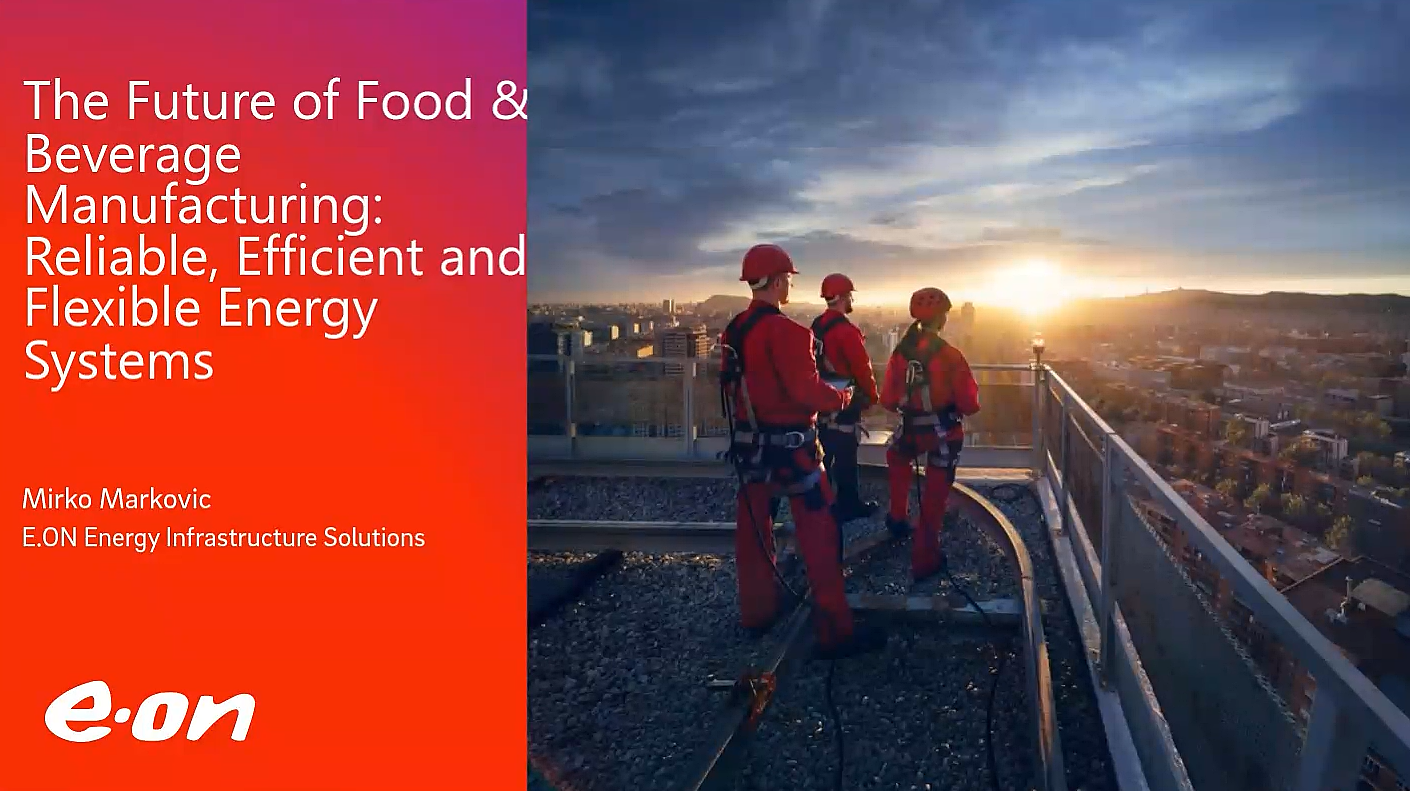
In a new webinar, Mirko Markovic, Business Development Manager at E.ON Energy Infrastructure Solutions, discusses how F&B manufacturers can take this practical, site-specific approach. Rather than starting with new equipment, the priority is to understand existing processes and energy flows, then connect and optimise them. Making more of the energy already in use can strengthen resilience and help future-proof plants against further energy shocks.
Rethinking energy for F&B manufacturing

Markovic sets out how manufacturers can reshape their energy systems without compromising production. “We do not start with one standard product. We start by understanding the site,” he says, meaning examining production processes, energy flows and existing infrastructure before deciding what to change. It also means balancing three priorities that can pull in different directions: affordability, lower emissions and security of supply. In F&B production, reliability is essential. A failure in cooling can put products at risk, while a loss of heat for cleaning or pasteurisation can halt production.
One opportunity lies in the relationship between cooling and heating. A plant may use energy to remove heat from products, then burn gas to produce heat for cleaning or other processes. Heat pumps can help connect those demands, recovering heat from chillers and raising its temperature for productive use. In suitable conditions, one unit of electricity can deliver three or more units of heat. Where cooling and heating are needed simultaneously, the system can serve both needs.
Potential gains depend on the details
Lowering the temperature required by a process can improve heat-pump efficiency and strengthen the business case. Markovic illustrates this with a common mismatch: a site may generate high-temperature steam to heat water that only needs to reach 60°C. Instead of using steam throughout the facility, manufacturers can reserve it for processes that genuinely require high temperatures and meet other needs with lower temperature heat. “If you first reduce the demand, the new system can be smaller, cheaper, and more efficient,” he says.
That shift calls for a whole-system approach. Manufacturers can look for waste heat from chillers and air compressors, improve the way energy moves around the site, and use thermal storage to manage periods of peak demand. Storage allows heat to be produced when it is economical and used when production needs it. These measures can be introduced progressively, with new equipment operating alongside existing boilers while the site moves towards a more efficient system. In fact, argues Markovic, the way the system is run matters as much as the equipment. “A large part of the value comes from how intelligently the system is operated every day,” he says.
E.ON’s Flex approach combines production forecasts with energy-market data, weather and operational constraints to adjust how and when assets operate. Heat pumps and electric boilers might run when electricity is less expensive, charging thermal storage for later use. During higher-price periods, stored heat or existing boilers can help meet demand. The aim is to adapt energy use without disrupting production. “The production team must be able to trust the new system from day one,” notes Markovic.
How E.ON can help F&B manufacturers
For companies concerned about the cost and complexity of investment, Markovic describes an energy-as-a-service model in which E.ON can finance, own and operate the system, while the customer pays for the energy services it receives. This can help manufacturers preserve capital for their core operations, while having a partner responsible for system performance.
Planning beyond the factory gate is also important. As sites electrify, they may need greater grid capacity, and securing a connection can take years. Markovic encourages companies to plan early and assess investments over their full lifetime, taking account of future carbon costs rather than focusing only on initial outlay or short-term payback.
Markovic concludes by reminding us that manufacturers do not need to transform everything, all at once. By understanding process needs, recovering energy, improving infrastructure and combining technologies carefully, they can build more flexible and lower-carbon systems while keeping production running.
To watch the full webinar The Future of Food & Beverage Manufacturing: Reliable, Efficient and Flexible Energy Systems click below.
[i] https://ec.europa.eu/newsroom/ecfin/newsletter-archives/75558
